Tuesday, 25 September 2018

EUROPEAN DAY OF LENGUAGE

The European Day of Languages ​​is celebrated every year on September 26th as a tribute to linguistic diversity, the committee of ministers decided to declare a "European Day of Languages." Its main objective is to increase language learning throughout Europe.


This day is the ideal occasion to:
• Encourage people to learn languages.
• Promote the diversity of cultures and languages.
• And to sensitize the great variety of languages ​​that exist in Europe.


I think that learning languages ​​is very important because it helps you to look for work more easily and you can also work in other countries, you have more culture, you can communicate with other people ...
At school I learn English and French, I think they are the two most useful languages, but I would like to learn Italian because it is very beautiful. I speak Spanish and Catalan.

Monday, 24 September 2018

WELCOME

Hi, my name is Marta and I´m 12 years old. I was born in Andorra, but I live in Salamanca because my family is here. I study in IESO Tomás Bretón
I like swimming, drawing, and go out with my friend.


Monday, 11 June 2018

GLOSSARY U.5

COMPASS - brújula
BINOCULARS - prismáticos
TOOLS - herramientas
BACKPACK - mochila

PRESENT CONTINUOUS

SIMPLE PAST

AFIRMATIVE
REGULAR FORMS (ARRIVE)                                                    IRREGULAR FORMS (DRINK)

I                                                                                                       I
YOU                                                                                               YOU
HE/SHE/IT         ARRIVED                                                          HE/SHE/IT           DRANK
WE                                                                                                  WE
YOU                                                                                                YOU
THEY                                                                                              THEY


INTERROGATIVE
REGULAR FORMS                                                                             IRREGULAR FORMS 

                      I                                                                                                     I
                      YOU                                                                                              YOU
   DID           HE/SHE/IT    ARRIVE?                                          DID               HE/SHE/IT    DRINK?
                     WE                                                                                                 WE
                     YOU                                                                                               YOU
                    THEY                                                                                              THEY

NEGATIVE
REGULAR FORMS                                                                           IRREGULARS FORMS

I                                                                                                            I
YOU                                                                                                     YOU
HE/SHE/IT    DIDN´T    ARRIVE                                                      HE/SHE/IT    DIDN´T    DRINK
WE                                                                                                       WE
YOU                                                                                                     YOU
THEY                                                                                                  THEY


Wednesday, 16 May 2018

STREET ART PROJECT


Street Art in London


SECONDARY AND TERCIARY COLOURS


SRTEET ARTIST(INKIE)


Monday, 7 May 2018

PASTEL

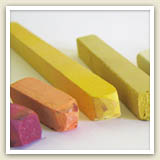
Pastel are usually in stick form, similar to chalk. A pastel stick consist of pure powered pigment and an inter binder, such as gum arabic. Pastels have a higher pigment used in pastels are similar to those found in oil paints.
Pastels can be hard or soft. Soft pastels have more pigment and less binder,so they are easier to smudge and have bringhter colors. Hardnpastels have less pigment and more binder than soft pastels. Harsd pastels can stay relatively sharp, so they are ideal for pastel artwork that requires tight detail.

 
Pastel artwork can either be referred to as a "pastel", a "pastel painting" or a "pastel drewing".
A pastel painting refers to a pastel artwork in which the paper is fully covered in pastel. If the surface of the paper is not totally covered in pastel, then it is referred to as a pastel drawing.


Making your own pastels is bit more complicated, but overall it is still a fairly easy process. Here are the steps to making your own pastels.


1. Place powered gum into a glass jar, add water and mix to dissolve. Close the jar and refigerate it for at least 48 hours. The mixture will become a gelatinous solution.


 2. Place powered pigment on a glass palette. Make a hole in the middle of the pile of pigment. Pour a very small amount of the gum solution into the center of the pigment. Using a palette knife, mix the pigment and the gum solution.


3. Is necessary, add more gum solution. Mix thoroughly until the mixture reaches a doughy consistency.


4. To make a lighter shade of blue, add a pile of white pigment to the remaning blue pastel. Add a small amount of gum,  and repeat the mixing process.    


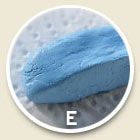
5. Mold the doughy pastel into a stick from. Place the pastel on absorbent paper, such as a paper towel. Allow the pastel to dry. You can create your pastels in any shape that you want, depending on what you might want to use it for.

Thursday, 3 May 2018

ULTRAMARINE

The finest blue know to the ancients, was obtained from the precious stone lapis lazuli.

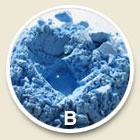
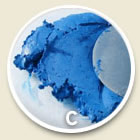
Lapis lazuli has been mined for counties from a location still in use today in the mountain valley of Kokvha, Afghanistan. First mined 6.000 years algo, the rock was transported to Egypt and late to Europe where it was used in jewelry and paint pigment Europeans called the expensive powered pigment ultramarine, which literally means over the sea.
Since the 19 century, ultramarine has been manualfactured artificially.

Ultramarine blue is historical pigment having been found in Egyptian tomb paintings. Syynthetic ultramarine was produced at the beginning of the nineteenth Century.