Showing posts with label ARTS. Show all posts
Showing posts with label ARTS. Show all posts
Wednesday, 16 May 2018


Monday, 7 May 2018
PASTEL
Pastel are usually in stick form, similar to chalk. A pastel stick consist of pure powered pigment and an inter binder, such as gum arabic. Pastels have a higher pigment used in pastels are similar to those found in oil paints.
Pastels can be hard or soft. Soft pastels have more pigment and less binder,so they are easier to smudge and have bringhter colors. Hardnpastels have less pigment and more binder than soft pastels. Harsd pastels can stay relatively sharp, so they are ideal for pastel artwork that requires tight detail.

Pastel artwork can either be referred to as a "pastel", a "pastel painting" or a "pastel drewing".
A pastel painting refers to a pastel artwork in which the paper is fully covered in pastel. If the surface of the paper is not totally covered in pastel, then it is referred to as a pastel drawing.
Making your own pastels is bit more complicated, but overall it is still a fairly easy process. Here are the steps to making your own pastels.

1. Place powered gum into a glass jar, add water and mix to dissolve. Close the jar and refigerate it for at least 48 hours. The mixture will become a gelatinous solution.

2. Place powered pigment on a glass palette. Make a hole in the middle of the pile of pigment. Pour a very small amount of the gum solution into the center of the pigment. Using a palette knife, mix the pigment and the gum solution.

3. Is necessary, add more gum solution. Mix thoroughly until the mixture reaches a doughy consistency.

4. To make a lighter shade of blue, add a pile of white pigment to the remaning blue pastel. Add a small amount of gum, and repeat the mixing process.

5. Mold the doughy pastel into a stick from. Place the pastel on absorbent paper, such as a paper towel. Allow the pastel to dry. You can create your pastels in any shape that you want, depending on what you might want to use it for.
Pastels can be hard or soft. Soft pastels have more pigment and less binder,so they are easier to smudge and have bringhter colors. Hardnpastels have less pigment and more binder than soft pastels. Harsd pastels can stay relatively sharp, so they are ideal for pastel artwork that requires tight detail.
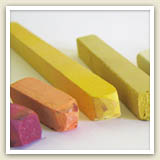
Pastel artwork can either be referred to as a "pastel", a "pastel painting" or a "pastel drewing".
A pastel painting refers to a pastel artwork in which the paper is fully covered in pastel. If the surface of the paper is not totally covered in pastel, then it is referred to as a pastel drawing.
Making your own pastels is bit more complicated, but overall it is still a fairly easy process. Here are the steps to making your own pastels.
1. Place powered gum into a glass jar, add water and mix to dissolve. Close the jar and refigerate it for at least 48 hours. The mixture will become a gelatinous solution.
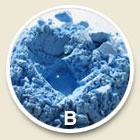
2. Place powered pigment on a glass palette. Make a hole in the middle of the pile of pigment. Pour a very small amount of the gum solution into the center of the pigment. Using a palette knife, mix the pigment and the gum solution.
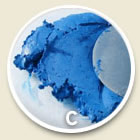
3. Is necessary, add more gum solution. Mix thoroughly until the mixture reaches a doughy consistency.
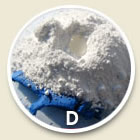
4. To make a lighter shade of blue, add a pile of white pigment to the remaning blue pastel. Add a small amount of gum, and repeat the mixing process.
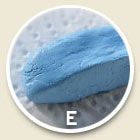
5. Mold the doughy pastel into a stick from. Place the pastel on absorbent paper, such as a paper towel. Allow the pastel to dry. You can create your pastels in any shape that you want, depending on what you might want to use it for.
Thursday, 3 May 2018
ULTRAMARINE
The finest blue know to the ancients, was obtained from the precious stone lapis lazuli.
Lapis lazuli has been mined for counties from a location still in use today in the mountain valley of Kokvha, Afghanistan. First mined 6.000 years algo, the rock was transported to Egypt and late to Europe where it was used in jewelry and paint pigment Europeans called the expensive powered pigment ultramarine, which literally means over the sea.
Since the 19 century, ultramarine has been manualfactured artificially.
Ultramarine blue is historical pigment having been found in Egyptian tomb paintings. Syynthetic ultramarine was produced at the beginning of the nineteenth Century.

Lapis lazuli has been mined for counties from a location still in use today in the mountain valley of Kokvha, Afghanistan. First mined 6.000 years algo, the rock was transported to Egypt and late to Europe where it was used in jewelry and paint pigment Europeans called the expensive powered pigment ultramarine, which literally means over the sea.
Since the 19 century, ultramarine has been manualfactured artificially.
Ultramarine blue is historical pigment having been found in Egyptian tomb paintings. Syynthetic ultramarine was produced at the beginning of the nineteenth Century.
Wednesday, 14 March 2018
SYMETRY

REFLECTION SYMETRY: Is a shape quality which is form by two halves facing each other with an axis or fold line in between as if both sides were mirrow images of each other.
SYMETRY AXIS: Is a line which divide a shape into two simesetic halves.Every element of the shape is reflected on the other side and at the same distance from the axis.
CENTRAL SYMETRY: Is the reflectan of an object through a paint called the symetry center. Every symetric points is an the other side and at the same distances from the center of symetry.
GEOMETRY SYMETRY: Is a kind of symetry which follows accurarely the geometric symetry rules.
APPARENTS SYMETRY: Is the quallity of shapes or objects which show an obvius symetry but not every point or element follows accurarely the geometric symetry rules.
SYMMETRICAL BALANCE: It is a way to organize parts of an image, picture or drawing so one side duplicates or mirrors the other.
POLYGONS

STAR POLYGONS: It is a particular polygon case with a star shape, created out of linkong together non consecutive vertice of a regular polygon.
INSCRIVED POLYGONS: They are a polygons placed inside circles so all the vertices of the polygons are placed on the circle.
CIRCUNSCRIBED POLYGONS: They are polygons surrounding a circle, being its sides tangent to the circle inside.
POLYGONS PARTS

SIDE: Each of the line segments that form a polygon.
VERTEX: The point in whith two sides or edges meet.
DIAGONAL: Segment line that connects non consecutive vertices.
PERIMETER: The path around a polygon, the addition of all its sides.
APHOTEM: Line segment from the center to yhe mindpoint of one of its sides.
Subscribe to:
Posts (Atom)